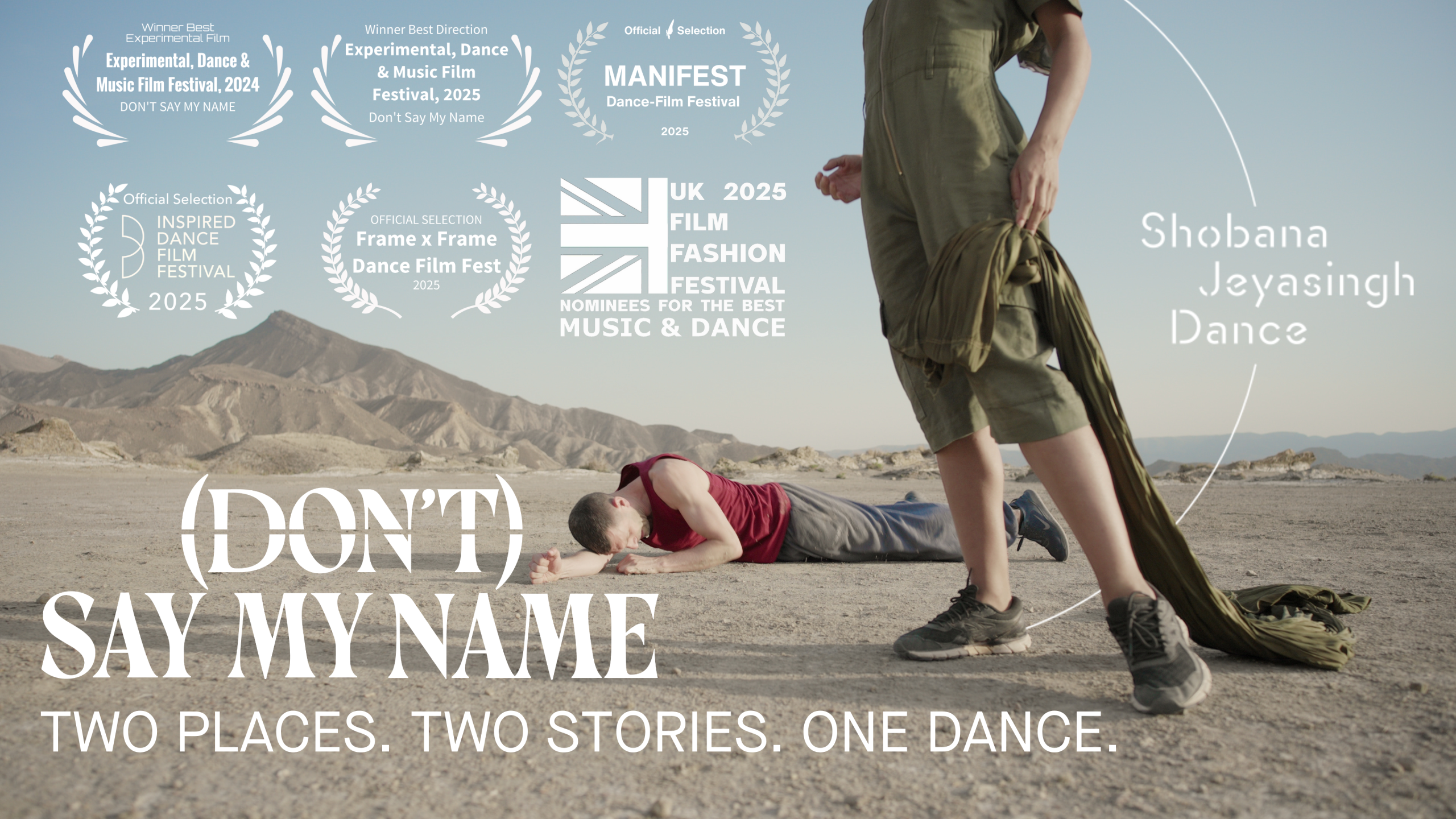
(Don’t) Say My Name gives Claudio Monteverdi’s operatic scene, II Combattimento di Tancredi e Clorinda, a contemporary twist.
Monteverdi’s piece is set in the first Crusades and describes a fierce combat between a European knight and a female Saracen warrior.
In our retelling of this story, a group of dancers rehearse the work in a studio. On tour abroad, they encounter a stranger who seems to have stepped out of their story but does not want to be in it.
Shot in locations in London and Spain, (Don’t) Say My Name is a poetic and layered exploration of otherness, conflict and reconciliation.
Currently being showcased at selected film festivals.
Film Festivals
Experimental, Dance & Music Film Festival (CA)
Winner Audience Award: Best Experimental Film (2024)
Movement is at the heart of choreography – but how is it generated and how does it become choreography? Shobana and six company dancers talk about what happens inside the dance studio.
In previous episodes of our Surface Tension podcast, we’ve looked at choreography from a range of different viewpoints: the themes of science and science fiction, the considerations required for site-specific works, and the creative inputs of writers, musicians, film-makers and designers – as well as virologists and clergymen!
But there’s one vital group of people we haven’t spoken to in detail: the dancers themselves. So in this episode, we open a window onto the rehearsal studio as Guardian dance writer Sanjoy Roy finds out about the interactions between dancers and choreographer, and between dance and choreography.
Shobana Jeyasingh puts the moment in context: when she first meets the dancers in the studio, much “choreographic” work has already been begun outside it – research undertaken, ideas and themes sketched out, collaborators commissioned.
Listen to Shobana and six experienced dancers – José Agudo, Carmine de Amicis, Avatâra Ayuso, Catarina Carvalho, Estela Merlos and Sooraj Subramaniam – talking about what happens inside the studio.
We find out about the dancers’ very varied technical training – ballroom, jazz, folk and flamenco as well as ballet, contemporary and bharatanatyam – and about how they work together so that their many different voices contribute to the same artistic conversation.
The dancers talk about the depth of research and the scope of their contribution, both physically and mentally, and what it’s like to be part of a picture on the inside while Shobana has the view from the outside.
Shobana talks about creating frames for tasks, why it’s ok to lose rungs from the ladder, and why she feels like a film director. And have you ever wondered what the difference is between dance and choreography? She pinpoints one crucial distinction between a dance sequence and a choreographic phrase.
Of course, what goes into the studio eventually comes out of it. How does it feel for the dancers and for the choreographer when their closed creation finally becomes a public performance?
Episode 5 of Surface Tension charts the process of creation, rehearsal and touring of Staging Schiele (2019). Presenter Sanjoy Roy chats to Shobana, composer Orlando Gough, costume designers COTTWEILER, visual artist Ben Cullen Williams and dancers Dane Hurst, Estela Merlos and Catarina Carvalho about their respective collaborations on the piece.
Watch all episodes of the Surface Tension podcast on our You Tube channel.
Presenter Sanjoy Roy introduces the latest production which the company have just toured, Staging Schiele and talks to Shobana about the origins of the piece and how her interest in the life, work and death of Egon Schiele was sparked. Conversation covers the rehearsal process, what parts of Schiele’s life and paintings were reflected in the choreography and themes of the male artist and the female nude.
Shobana describes the sections of the piece: Mirror / Doppleganger / In the Studio (later called Radical Nude / Censor / Relationships (Schiele with his mother, wife and muse).
We jump back to May 2019, when Shobana and company were in the research and development phase for the piece. We talk to company dancer Dane Hurst, who took on the Schiele role, about the research period and using imagery to inspire movement.
Fast forward to September 2019, when Sanjoy caught up with Shobana whilst she was making changes to the storyline. Then we hear from composer Orlando Gough, where he talks about the notion of anxiety and how to incorporate it within the music. The music is almost all sung, whispered and shouted by one male voice, which we assume to be Schiele.
Next we chat to menswear designers COTTWEILER: Ben Cottrell and Matthew Dainty who talk about getting a feel for Shobana’s take on Staging Schiele, research processes and meeting the dancers before starting to design the costumes. They take into consideration how possible fabrics react to the lighting, stage and set in a very detailed way.
Ben Cullen Williams, visual artist, describes his approach to designing the set, a location for the piece. He designed the steel frame structure to be collapsable and flatpack so it could fit in a van. The set provided a structure for the piece but also the psychological state of Schiele which the dancers existed in. The lighting was designed to give a sense of disturbance, unease and anxiety with constant flickering and twitching in and around the set.
November 2019, in the foyer of Queen Elizabeth Hall after the London Premiere of Staging Schiele Sanjoy interviews Orlando Gough about the ‘most intense dance piece I’ve ever seen’.
Dancers Catarina Carvalho, Dane Hurst and Estela Merlos talk about performing across the duration of the tour, injuries, how they supported each other and how the tone of the piece matured and changed.
Finally we talk to Shobana after the performance, about the audience reaction and energy in the auditorium, the challenges of putting on a show, the creative team achieved, and the ’synergy of vision amongst the creative collaborators’ on Staging Schiele.
Episode 4 of Surface Tension investigates the impact of science and science fiction on Shobana’s work. Presenter Sanjoy Roy asks what are the connections between science and dance, and sci-fi and Shobana’s choreography? Phantasmaton (2002), In Flagrante (2014), Trespass (2015) and Contagion (2018) feature in this episode.
Watch all episodes of the Surface Tension podcast on our You Tube channel.
Episode 3 of Surface Tension focusses on three site-specific works: Counterpoint (performed in the courtyard at Somerset House), TooMortal (presented in various churches) and Outlander (a monastery in Venice).
Watch all episodes of the Surface Tension podcast on our You Tube channel.
In this episode, presenter Sanjoy Roy opens by asking Shobana about the practical and artistic questions of making site-specific work for different spaces outside of theatres. We speak to Jenny Waldman who commissioned Counterpoint in 2010 to be performed in and amongst the fountains in the courtyard of Somerset House. 20 female dancers were specifically chosen to dance in the 55 fountains of this vast and classical space.
TooMortal was commissioned by Dance Umbrella and the Venice Biennale to be performed in churches. Shobana and Father Allan Scott, former Rector of St Mary’s Old Church in London, describe the incredible difficulty in finding a church in Venice that would allow dance to take place. Too strange? Not suitable? Women dancing in the pews? In the end St George’s Anglican Church in Venice agreed to take piece… We talk to Betsy Gregory, former Artistic Director for Dance Umbrella, about the excitement around programming for non-theatre spaces and putting dance in unusual locations.
In the third section, we move on to Outlander from 2016, made for a monastery in Venice, which used to house the painting ‘Wedding at Cana’ by Paolo Veronese. Sander Loonen joins the discussion via skype to talk about his role as production manager and the staging for this very bespoke piece.
Shobana recounts that the initial inspiration came from Veronese’s exuberant masterpiece which features a contemporary, multicultural wedding feast. Performed by three company dancers, it is a closely observed series of solos that shift between reflection and speed. The work contrasts Shobana’s choreography with the classical beauty of Venice. Each dancer becomes a character who brings their own mixture of strangeness and familiarity to Veronese’s celebrations on a specially designed catwalk lit by Sander Loonen and with a baroque inspired soundscape by Scanner.
Episode 2 of our podcast, Surface Tension, turns the spotlight on Faultline from 2007, with contributions from author Gautam Malkani, composers Robin Rimbaud (Scanner) and Errollyn Wallen, filmmaker Pete Gomes and of course Shobana.
Watch all episodes of the Surface Tension podcast on our You Tube channel.
In this episode presenter Sanjoy Roy recollects his memories of Faultline, the style, aesthetic and evocative atmosphere. The anxiety, the coolness and the swagger of what it meant to be young, British and Asian at that time. He speaks to Shobana about the triggers that shaped the piece; the 2005 London bombings, subsequent raids and the hysterical unease that was pervasive in every day life. All of which contributed to the look and feel of Faultline.
Shobana talks about the various creative collaborations that all knitted together in the final piece; the film which acted as the prologue, the initial introduction of the dancers, characters and music – in particular the voice of Patricia Rozario. Plus the direct influence of Gautam Malkani’s book Londonstani, published in 2006, which had a profound effect on the movement generation phase of Faultline.
We talk to author Gautam Malkani about his own experience of growing up in London, the culture adopted by Asian rude-boy gangs. He talks about the hyper masculinity, language, posing and posturing that characterised his book and reads some excerpts. We hear Gautam’s reaction on hearing that his book had inspired a dance piece and how Shobana was able to encapsulate the essence and themes in a very direct choreography of raw aggression.
We speak to Robin Rimbaud (Scanner) who composed the score for Faultline. Shobana wanted him to create a soundscape that produced a dark, charged and intense atmosphere; a sonic picture of London in 2007 using electronic music. Composer Errollyn Wallen joins the conversation to talk about how she collaborated and shaped the music to compliment Robin’s soundscape.
In the final section we interview artist and filmmaker Pete Gomes who produced the visuals and the approach he agreed on with Shobana.
2019 marked the 30th anniversary of Shobana Jeyasingh Dance. To celebrate we produced a series of podcasts exploring Shobana’s work, her pioneering vision and her contribution to the UK’s cultural landscape.
Join Guardian Dance critic Sanjoy Roy as he interviews Shobana, company dancers and collaborators to examine the themes and inspiration behind her adventurous work. We delve into the archives to find out how Shobana’s choreography did (or didn’t) fit into the dance scene 30 years ago, her research and creative processes, dance styles and the alternative path she has taken from the outset of her career.
Watch all episodes of the Surface Tension podcast on our You Tube channel.
Episode 1. Configurations
‘System, meet system.’ When Shobana Jeyasingh met Michael Nyman.
Sanjoy Roy speaks to choreographer Shobana Jeyasingh and composer Michael Nyman to get their take on how the Configurations collaboration came about. Each share memories about the process, research and how they combined contrasting elements of Western contemporary music and Indian classical music.
Shobana tells how the relationship between choreographer and composer was all about communicating patterns of rhythm, in this instance, with no shared musical history and details the challenges of representing Bharatha Natyam dance via a string quartet.
After first hearing Michael’s score Shobana recounts her initial impressions, running around the sound world trying to find information that dancers needed. We hear how the piece finally came together with choreography and music and how it evolved into quartet, via a trio. Shobana talks through the balancing act between the visuals and the richness of the music.
Presented by Sanjoy Roy
Produced by Melissa FitzGerald
Shobana was commissioned to produce a lens-based work in collaboration with leading geneticist Dr Kim Nasmyth of Oxford University. It formed part of the MitoSys exhibition ‘Lens on Life’, curated by Marina Wallace, director of Artakt at the University of the Arts in London.
In Flagrante is inspired by the tension and instability inherent in cell division. It is made in collaboration with film-maker Ravi Deepres and features dancer Avatâra Ayuso.
European Union project MitoSys is a major multi-national research initiative in 2014/2015 that aims to deepen public understanding of how cells divide. Part of this project pairs up four leading scientists with four European artists.
Three female dancers, filmed inside and outside three London office buildings, perform a mixture of vocabulary from contemporary dance and the traditional, Indian classical dance form of Bharata Natyam.
Shobana presented one of her works, Bruise Blood, to six academics with a professional interest in the human body, and asked them to comment from their specialist perspective. These personal, insightful writings became the scripts for six individual film portraits.
Each film, shot in or around King’s College London, draws attention to unexpected commonalities, connecting disparate ideas. Defining them is the question of how we make sense of and portray the human body – in dance, in science, in a robot-led future, and through the lens.
Translocations was created as part of the Knowledge Producers programme, developed by the Cultural Institute at King’s. This programme connects King’s College London with artists, creating space to challenge conventions and discover original perspectives.
Sign up to our e-newsletter bringing you the latest company news and shows.
Our e-newsletters include information about our work, events, fundraising appeals and learning activity. We’ll also send you occasional additional emails during tour periods featuring photo galleries, articles and trailers.
We use cookies on our website to give you the most relevant experience by remembering your preferences and repeat visits. By clicking “Accept All”, you consent to the use of ALL the cookies. However, you may visit "Cookie Settings" to provide a controlled consent.
This website uses cookies to improve your experience while you navigate through the website. Out of these, the cookies that are categorized as necessary are stored on your browser as they are essential for the working of basic functionalities of the website. We also use third-party cookies that help us analyze and understand how you use this website. These cookies will be stored in your browser only with your consent. You also have the option to opt-out of these cookies. But opting out of some of these cookies may affect your browsing experience.
Necessary cookies are absolutely essential for the website to function properly. These cookies ensure basic functionalities and security features of the website, anonymously.
Analytical cookies are used to understand how visitors interact with the website. These cookies help provide information on metrics the number of visitors, bounce rate, traffic source, etc.